
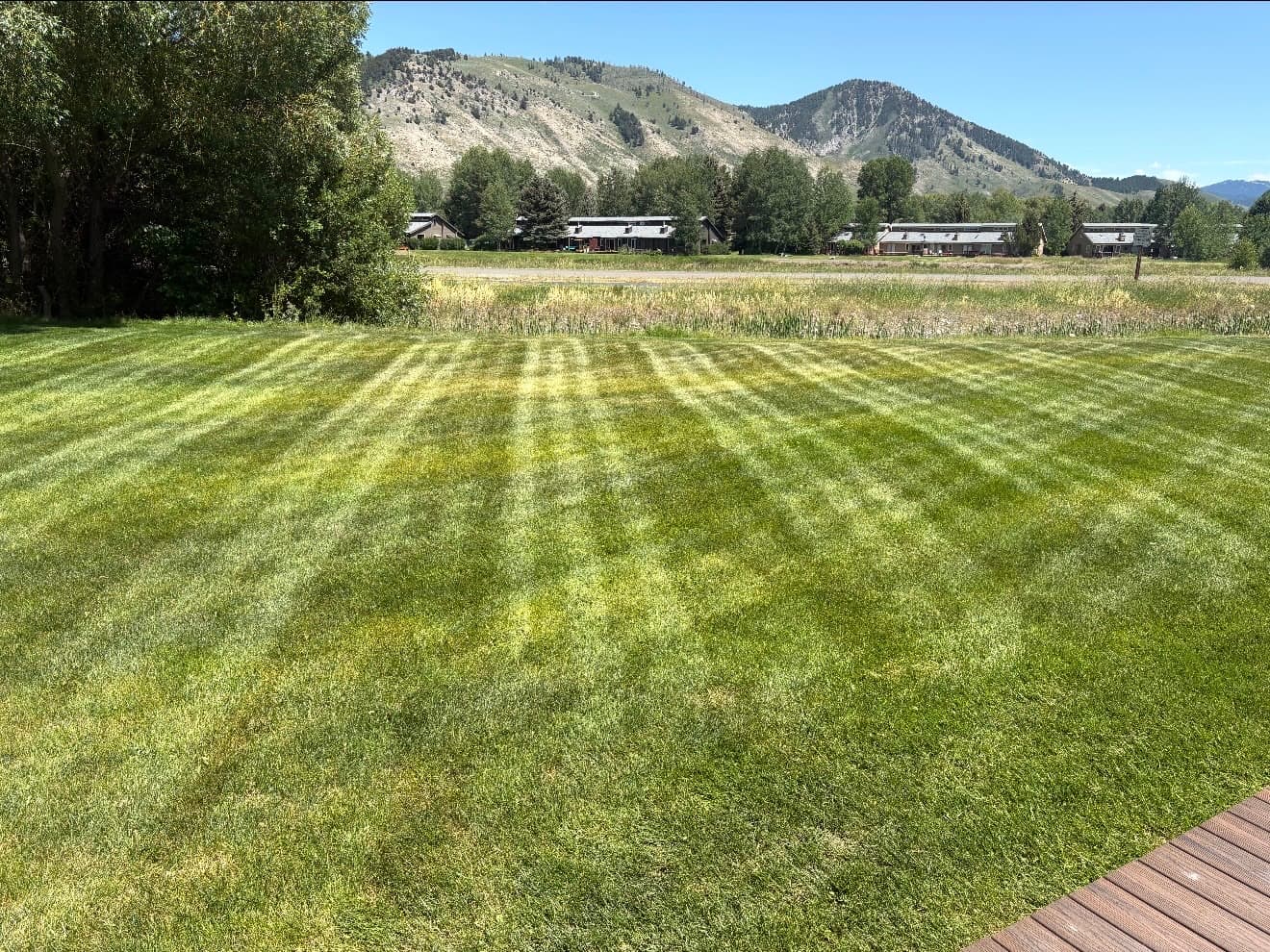
This gets asked more than almost anything else, usually after somebody has knocked on the door offering a seven-application program. The honest answer is that some Jackson Hole lawns genuinely need feeding and some are being sold a schedule they will never get value from. The difference is not the lawn. It is the soil under it and how the property is watered.
Why Jackson soil is the whole question
Most of this valley sits on thin, rocky, alkaline soil over glacial gravel. There is not much organic matter holding nutrients in place, and water moves through it fast. That means two things at once: the soil genuinely runs short on nitrogen, and anything you put down leaches quickly if it is applied wrong. A lawn on eight inches of imported topsoil behaves completely differently from one on four inches over river rock, and those two properties can be on the same street.
When fertilizing is worth the money
- New sod or a recent install. Grass with no established root system in thin soil has nothing to draw on and needs feeding to get through its first two seasons.
- A lawn that thins or yellows every July no matter how much you water it. That is usually nitrogen, not drought.
- High-traffic property. Rentals, dogs, and kids pull more out of a lawn than it replaces on its own.
- A lawn you actually irrigate. Fertilizer without consistent water does nothing useful and can burn.
When it is wasted money
- A lawn that is thin because it is compacted or shaded. Feeding compacted soil does not fix compaction. Aeration does.
- A lawn with no irrigation. Unwatered grass here goes dormant in midsummer, and fertilizing dormant grass is money on the ground.
- Late fall applications on a lawn already heading into dormancy. The season closes early here and the timing windows are narrower than the national programs assume.
- Anything applied on a schedule written for a climate with twice our growing season. A seven-step program designed for the Midwest is three or four steps too many for Jackson.
The timing that actually matters here
The growing window in Jackson Hole is roughly late May through September, and it moves around by a couple of weeks depending on the year and how high the property sits. Feeding too early, before the soil has warmed, feeds weeds rather than grass. Feeding too late, when the lawn is already shutting down, does almost nothing. In practice most properties here do well on a small number of correctly timed applications, weighted toward spring green-up and a late-summer feeding that goes into root storage before winter.
Aeration is usually the bigger lever
If a lawn is struggling and the soil is thin and packed, aeration does more than any fertilizer will. It opens the soil so water, air, and whatever you do apply can reach the roots instead of running off. On a lot of the properties we look at, the right sequence is aerate first, then feed, and skip half the applications somebody quoted.
How to tell which one you have
Dig a small plug out of the lawn with a spade and look at it. If you hit rock at three or four inches, you have a soil problem and a feeding program alone is not going to solve it. If there is real soil and the grass roots are still shallow and pale, feeding will help. That is a five-minute check anyone can do before agreeing to a season of applications.
We will do that check for free when we walk a property, and if the answer is that your lawn does not need a fertilization program, we will tell you that. Selling somebody four applications they do not need is how you lose the maintenance account that was actually worth having.